12 Affordable SEO Services for Small Businesses
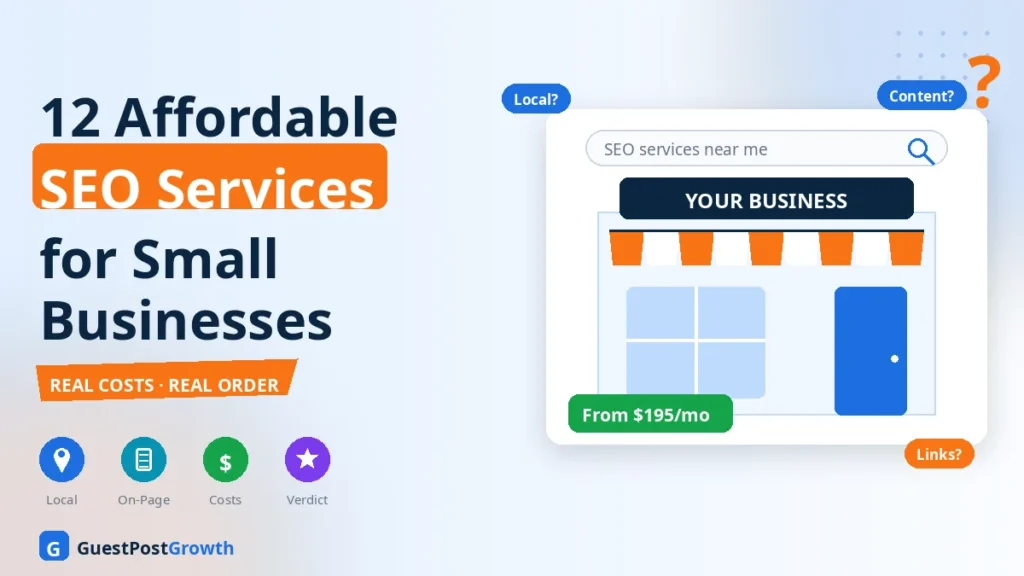
Search for affordable SEO services and you will drown in packages: bronze, silver, gold, “guaranteed rankings,” 500 keywords tracked, 10,000 directory submissions. Almost none of them answer the only question that matters to a small business — what work will actually be done on my website, and why that work first?
This guide answers it differently. It walks through the twelve SEO services a small business can genuinely buy, in plain language: what each service is, what a decent version of it includes, who it suits, what it typically costs, whether you can do it yourself, and how long it honestly takes to matter. Where we sell the service ourselves, our real prices are printed next to the market ranges, so you can compare us against the market instead of taking our word for anything.
The Small Business SEO Problem, Stated Plainly
A small business does not lose on Google because it lacks some secret tactic. It loses for boring reasons: its Google Business Profile is half-filled, its service pages say less than its competitors’ pages, its website has technical faults nobody has looked at since it launched, and bigger brands out-publish and out-link it every month. Meanwhile its SEO budget — if it has one — is a few hundred dollars a month, competing against companies that spend that on a single article.
The good news is that small-business SEO is mostly a game of fixing the boring reasons in the right order. You do not need every service on this list. You need the ones that match the reason your site is losing — and the discipline to buy them in sequence instead of spreading a small budget thinly across everything at once.
How to Judge Whether an SEO Service Is Actually Affordable
“Affordable” does not mean cheapest. A $99 package that changes nothing is more expensive than a $390 package that fixes your service pages, because the first one buys a report and the second buys an asset. Judge every service on this page — and every provider, including us — with the same four questions:
- What exactly will be done? Named tasks on named pages. “SEO activities” is not an answer.
- What will I be able to see afterwards? A changed page, a live link, a corrected listing, a report with URLs — something checkable.
- What does it not include? Honest scope limits are a good sign; packages that include everything usually deliver nothing in particular.
- What happens if it does not work? Written terms, cancellation rules and refund conditions — published before you pay, not negotiated after.
With that ruler in hand, here are the twelve services.
1. Local SEO and Google Business Profile Optimization
If your customers are within driving distance, this is the highest-value SEO service you can buy, and it is not close. Local SEO means showing up when someone nearby searches for what you do — the map results, the “near me” searches, the local pack. Its centrepiece is your Google Business Profile: the free listing that controls what Google shows about your business, and the one most small businesses set up once and never touch again.
What a decent service includes: a complete, corrected Business Profile (categories, services, hours, photos, attributes), a review routine (asking properly, replying properly), location and service pages on your website that match what the profile promises, and basic tracking of calls and direction requests so you can see it working.
Who needs it: any business with a physical location or a service area — trades, clinics, salons, restaurants, local shops, local professionals.
Typical cost: one-time setup and cleanup commonly runs a few hundred dollars; ongoing local management is usually bundled into monthly packages rather than sold alone.
Do it yourself or hire? The profile itself is genuinely DIY-able — it is your information, and Google lets you edit it free. Hire when locations multiply, the profile has errors or duplicates you cannot shift, or nobody in the business will actually keep it updated.
When you see movement: profile corrections and review growth can shift map visibility within weeks; it is usually the fastest-moving item on this list.
2. Local Citations and Business Listings
Citations are the mentions of your business name, address and phone number across the web — directories, maps, review platforms, industry listings. They sound old-fashioned, and design-wise many of them are, but they do two real jobs: they corroborate your details for Google (inconsistent addresses genuinely confuse local rankings), and they put you in the places customers browse when they are choosing.
What a decent service includes: an audit of your existing listings, correction of wrong or duplicate entries, and consistent submissions to the directories that matter for your country and trade — not a blast to thousands of junk directories, which is a 2010 tactic wearing a new price tag.
Who needs it: local businesses that have moved, rebranded, changed numbers, or never built listings beyond Google — and multi-location businesses, where inconsistency multiplies.
Typical cost: priced per location set; quality manual citation work costs more than automated blasts, and the difference is worth paying because corrections and consistency are the entire point.
Do it yourself or hire? The top ten listings for your trade, yes, by hand, in an afternoon. The long tail and the cleanup of bad data are what providers are for.
When you see movement: citations are a foundation, not a lever — expect them to support your local rankings over months rather than move anything this week.
3. On-Page SEO for Your Money Pages
On-page SEO is the unglamorous work of making each important page on your site clearly about one thing, structured so a skimming customer (and a crawler) understands it in seconds: the title, the headings, the opening paragraphs, the internal links, the calls to action. For most small businesses, the five to fifteen pages that describe their services matter more than everything else on the site combined — and those pages are usually the weakest ones, written once by the web designer and never revisited.
What a decent service includes: keyword mapping (one clear target topic per page), rewritten titles and headings, introductions that answer the searcher’s actual question, internal links between related services, image alt text, and removal of duplicated or competing pages that split your own rankings.
Who needs it: almost everyone, and usually first. If your pages are thin, duplicated or aimed at no particular search, no amount of links will fix the underlying problem — you would be pouring authority into a bucket with no bottom.
Typical cost: commonly priced per page or as a small project; expect to pay for thinking and writing, not software.
Do it yourself or hire? You can draft the content — nobody knows your services better. A professional pass on structure, keyword targeting and internal linking is where the value sits.
When you see movement: re-indexed pages can re-rank within a few weeks; on-page fixes are among the quicker wins when the pages were genuinely weak.
4. Technical SEO Audit and Fixes
Technical SEO is the plumbing: whether Google can crawl your site, index the right pages, and render them properly on a phone. Small business sites accumulate plumbing faults quietly — pages blocked by accident, redirect chains from an old redesign, a sitemap listing deleted pages, duplicate versions of the whole site competing with each other.
What a decent service includes: a crawl of the full site, an indexation review (what Google has, versus what it should have), fixes or a precise fix-list for your developer covering redirects, canonical tags, sitemap and robots files, mobile usability, page speed faults and structured data where it genuinely applies.
Who needs it: sites that were redesigned or migrated in the last two years, sites whose traffic dropped suddenly, and any site where pages exist that simply never appear in Google.
Typical cost: a one-time audit for a small site commonly runs from a few hundred dollars into the low thousands depending on size; insist on knowing whether fixes are included or only reported.
Do it yourself or hire? Run Google Search Console (free) and read its coverage and experience reports — that is your smoke alarm. The diagnosis and repair of anything beyond the obvious is specialist work.
When you see movement: unblocking an indexation fault can show results in days; general hygiene pays off as steadier crawling over the following months.
5. SEO Content Writing
Content is how a small business answers the questions customers ask before they buy — the guides, comparisons, cost pages and explanations that show up early in a search and quietly decide who gets the enquiry. It is also the service most often bought badly: a quota of generic articles, written to a word count, about topics nobody searched for.
What a decent service includes: topic selection from real search demand (not a content calendar invented in a meeting), articles written for a human reader first, service-page copy that sells as well as ranks, and internal links from new content into your money pages — the step cheap content always skips.
Who needs it: businesses whose competitors out-publish them, businesses in considered purchases (anything customers research before buying), and any site whose blog is a graveyard of company news.
Typical cost: per article or per page; quality writing costs noticeably more than commodity writing, and on this line item the difference is visible in the product itself — read a sample before you buy any quantity.
Do it yourself or hire? Founders write surprisingly good first drafts because they answer these questions daily. Many small businesses do best with a hybrid: your knowledge, their structure and editing.
When you see movement: new content typically needs two to three months to settle into rankings; it compounds — the tenth good article outperforms the first.
6. Guest Posting
Guest posting means publishing articles on other, relevant websites, with a link back to yours. Done properly it does three things at once: it earns links from publications in your field, it builds the topical breadth a small site cannot build alone, and it puts your name in front of readers who have never heard of you. Done badly — spun articles on sites that publish anything — it is money converted directly into risk.
What a decent service includes: real publications you can inspect before paying (with their metrics and prices listed, not revealed after), original articles written for each placement, sensible anchor text, and a delivery report with the live URLs. Our own guest post sites marketplace lists more than 1,500 publications with prices from $20 to $150 shown upfront, precisely so the inspection happens before the money.
Who needs it: businesses building authority in a niche, newer websites that need relevant referring domains, and brands that want to be seen on named publications.
Typical cost: per placement, driven by the publication; on our marketplace the range above is the honest spread, and anyone quoting one flat price for “guest posts” without naming sites is hiding the variable that matters.
Do it yourself or hire? Outreach is learnable but slow — pitching, follow-ups and writing eat days. Most small businesses buy placements and keep their hours for customers.
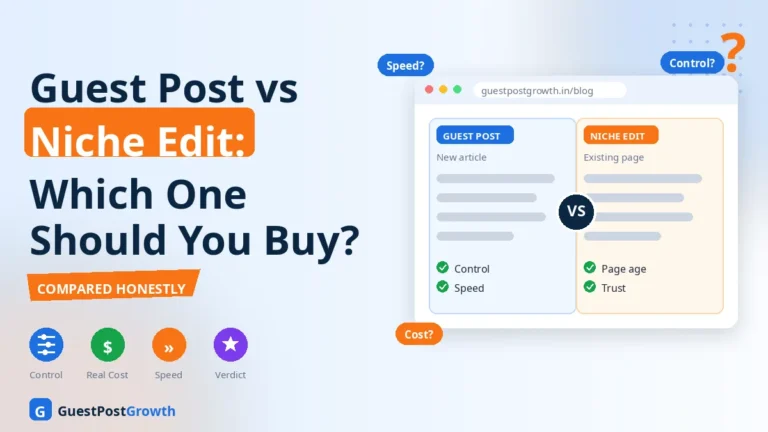
When you see movement: guest posts are a slow build — new pages need indexing and time; judge them over a quarter, not a fortnight. Our full comparison of the two main link types is in guest post vs niche edit.
7. Niche Edits (Link Insertions)
A niche edit adds your link into an article that already exists on a relevant site — a page that is already indexed, already trusted, sometimes already ranking. It is the service most “affordable SEO” lists quietly skip, because it does not fit the agency package model, but for a specific job it is often the best value on this page: strengthening one important page that is stuck just below where it should rank.
What a decent service includes: page-level vetting (what the specific page ranks for and links it holds — not just the domain’s score), a natural sentence and anchor agreed with you, and replacement cover if the link is later removed — ours includes a 12-month replacement promise on delivered editorial links, and you should ask every provider for their equivalent in writing. Our niche edits service starts at $41.
Who needs it: businesses with a service page sitting on page one or two that needs support, and niches where sites rarely accept new articles but will update existing ones.
Typical cost: per insertion, from tens of dollars on modest pages to a few hundred on strong ones; the page’s own evidence, not the domain badge, should drive the price.
Do it yourself or hire? Negotiating insertions into existing articles is relationship work; this is one of the least DIY-able services on the list.
When you see movement: usually the fastest of the link services, because the linking page was already crawled and trusted before your link arrived.
8. Press Releases and Digital PR
A press release distributes one genuine announcement — a launch, an opening, a study, a milestone — across news sites, earning coverage and links at a scale no small business could pitch manually. Digital PR is its bigger sibling: stories and data built to be picked up. For small businesses the release is the affordable entry point; what it is not is a magic authority button, and honest providers say so.
What a decent service includes: the writing (or a proper edit of yours), distribution to a real network of news outlets, and a placement report with live URLs you can open — ask to see a sample report before buying, from any provider. Our press release service starts at $39 for distribution to 100+ outlets, with larger packages reaching 200+.
Who needs it: businesses with actual news — launches, expansions, new locations, notable hires, original data — and new brands that need a base layer of coverage and branded mentions quickly.
Typical cost: per release; writing-included packages cost more than distribution-only, and both are one-time purchases rather than retainers.
Do it yourself or hire? You can write the announcement; the distribution network is the product, and that is what you are paying for.
When you see movement: coverage lands within days of distribution; treat the ranking effect as a supporting layer under the services above it on this list, not a strategy by itself.
9. Free and Low-Cost SEO Tools (The DIY Layer)
Not every item on an SEO shopping list needs a provider. A capable owner with the right free tools can handle measurement, basic research and several monthly checks personally — and knowing what the tools say makes you a far better buyer of everything else on this page.
What the free stack covers: Google Search Console (what Google actually sees: queries, pages, indexing problems — the single most important free tool in SEO), Google Analytics (what visitors do), and browser-side utilities for the daily small jobs: checking keyword density before you publish, previewing how your result will look in Google, generating meta tags and schema, building tracked campaign links. Our own SEO tools page collects ten such utilities, all free and running entirely in your browser.
Who needs it: every small business, including ones that hire everything else out. The owner who reads Search Console monthly cannot be sold nonsense.
Typical cost: zero for the stack above; paid suites (the big research platforms) start becoming worth it when content and competitors, not basics, are your bottleneck.
Do it yourself or hire? This is the DIY layer by definition — hire interpretation (a consultant, below) when the data confuses you, not more dashboards.
When you see movement: tools move nothing by themselves; they make every other service on this list measurably better aimed.
10. Ecommerce SEO
Online stores have a different disease: hundreds of pages, most of them near-duplicates (the same product in three colours), category pages that say nothing, and filters generating thousands of junk URLs. Ecommerce SEO is the specialised work of making the pages that sell — categories and best products — strong, while keeping the machinery from diluting them.
What a decent service includes: category page content and structure, product titles and descriptions that are not copied from the supplier, handling of variants, filters and out-of-stock pages, and internal linking that pushes authority toward the products with margin.
Who needs it: any store past a handful of products, and especially stores whose category pages are just grids of products with no text, no intent and no chance of ranking.
Typical cost: usually project or monthly work priced by catalogue size; expect it to cost more than brochure-site SEO because the page count — and the technical surface — is larger.
Do it yourself or hire? Product copy improvements are DIY-able in batches. Faceted navigation, canonical logic and crawl budget are not.
When you see movement: category improvements typically show over one to three months as pages are re-crawled and re-ranked.
11. SEO Consulting and One-Time Strategy
Sometimes the affordable option is not a service at all — it is a few hours of an expert’s judgement, after which your own team does the work. Consulting suits businesses with hands available (an owner, a marketer, a developer) but no map: which problems first, which can wait, which are not problems at all.
What a decent engagement includes: a prioritised written plan (not a 90-page audit export), the reasoning behind the order, and a follow-up check that the work was done correctly. A strategy session before a redesign or migration can be the highest-return SEO money a small business spends, because it prevents the most expensive mistake in this industry: rebuilding a site in a way that deletes its rankings.
Who needs it: businesses with internal hands, businesses about to rebuild or rebrand, and businesses that have been “doing SEO” for a year with nothing to show and need an honest second opinion.
Typical cost: hourly or per-session; a focused session costs less than one month of most retainers.
Do it yourself or hire? This is the hire — the judgement is the product. Everything after it can be DIY.
When you see movement: the plan is immediate; the movement depends on your team’s implementation over the following quarter.
12. Monthly SEO Retainers
The retainer is the bundle: an ongoing monthly arrangement where a provider steadily works through the list above — monitoring the technical health, improving pages, publishing content, building links, and reporting in plain language. It is the right shape for SEO, which is itself ongoing — but it is the wrong first purchase for a business that has not fixed its foundations, because a retainer spread across a broken site spends its first months doing the one-time work anyway.
What a decent retainer includes: a named set of monthly deliverables (not “SEO activities”), content and link work you can inspect, Search Console-based reporting tied to enquiries and sales rather than vanity metrics, and no lock-in that punishes you for leaving. Our own monthly SEO service starts at $195/month with published plan contents — compare the deliverable lists, ours included, before comparing prices.
Who needs it: businesses past the foundation stage, in markets competitive enough that standing still means sliding backwards, with enough margin that a steady flow of enquiries is worth a steady monthly cost.
Typical cost: legitimate small-business retainers commonly run from a few hundred dollars a month upward; below that, ask hard questions about what a human being can actually do for the money.
Do it yourself or hire? A retainer is the hire-everything option. Keep the free tools layer (item 9) in your own hands regardless, so you can read the reports with educated eyes.
When you see movement: compounding over three to six months is the honest expectation; anyone promising a retainer result in 30 days is selling, not forecasting.
What These Services Typically Cost: The Table
| Service | Typical structure | Honest cost picture |
|---|---|---|
| Local SEO / GBP | One-time setup, then monthly | Setup commonly a few hundred dollars; then usually bundled monthly |
| Citations | Per location set | Manual quality work costs more than automated blasts — worth it |
| On-page SEO | Per page / small project | Priced on writing and thinking time; beware per-page pennies |
| Technical audit | One-time project | A few hundred into low thousands by site size; check if fixes are included |
| Content writing | Per article / page | Quality writing visibly costs more; demand a sample first |
| Guest posting | Per placement | $20–$150 per placement on our marketplace, by publication |
| Niche edits | Per insertion | From $41 on our service; price should follow the page, not the domain |
| Press releases | Per release | From $39 (100+ outlets) on our service; writing included costs more |
| DIY tools | Free / freemium | $0 for the essential stack; paid suites when research is the bottleneck |
| Ecommerce SEO | Project / monthly | Priced by catalogue size; above brochure-site rates |
| Consulting | Hourly / per session | One session typically costs less than one month of a retainer |
| Monthly retainer | Monthly | From $195/month on our plans; a few hundred upward is the honest market band |
If You Have About $200 a Month: Buy in This Order
The question every small business actually asks — so here is a straight answer, in the order we would spend a small budget ourselves:
- Month 1 — Foundations you can see: Google Business Profile completed and corrected, the top citations cleaned up, Search Console verified and read. Much of this is free or DIY; spend only where data is a mess.
- Month 2 — Your money pages: on-page work on the three to five service pages that make you money. Titles, structure, intent, internal links.
- Month 3 — One real announcement: if you have anything newsworthy, a press release builds your base layer of coverage and branded presence in one purchase.
- Months 4–6 — Links, steadily: a modest monthly rhythm of guest posts for breadth and a niche edit behind the page closest to ranking. Small and steady beats a single splurge — and if the workload outgrows piecemeal buying, that is exactly the point where a monthly retainer starts paying for itself in coordination alone.
Red Flags: “Affordable” Services to Walk Away From
- Guaranteed rankings. Nobody controls Google’s results; a guarantee is a confession.
- Huge link counts at tiny prices. Thousands of links for the price of lunch are automated, and they are a liability, not an asset.
- No named deliverables. If they cannot say what will exist after month one that does not exist now, nothing will.
- Secret methods. Legitimate SEO is boring and explainable. “Proprietary techniques we can’t reveal” means techniques you would not approve of.
- Reports full of impressions, empty of work. Activity you cannot inspect did not necessarily happen.
- Lock-in contracts with exit penalties. Providers confident in their work — including us, on retainers with no lock-in — do not need to trap you.
Frequently Asked Questions
How much should a small business spend on SEO per month?
There is no universal figure, but there is a useful floor: enough to buy real human work every month. For many small businesses that means a few hundred dollars a month — our own retainers start at $195/month — or the same money spent in sequence on one-time services (foundations, then pages, then links) using the order in this guide. Below that level, the free DIY layer plus one or two targeted purchases will serve you better than a token package.
What is the most important SEO service for a small business?
The one that fixes your current bottleneck. For a local business it is usually the Google Business Profile and citations; for a business whose pages are weak, on-page SEO; for a site Google cannot crawl properly, technical fixes come before everything. Buying links for a site whose pages and foundations are broken is the most common way small budgets are wasted.
Can a small business do SEO itself?
A meaningful part of it, yes: the Business Profile, basic citations, reading Search Console, and content drafted from your own expertise are all realistically DIY, and our free SEO tools page covers the daily utilities. Providers earn their money on the specialist and relationship work — technical repair, outreach, insertions, distribution — and on simply doing the ongoing work every month without fail.
How long does SEO take to work for a small business?
Local profile and on-page fixes can move within weeks. Content and links compound over three to six months. Any provider who promises a specific ranking by a specific date is inventing it; a good one will show you the trend lines — impressions, rankings on the pages that matter, enquiries — and explain them monthly.
Is cheap SEO worth it?
Affordable SEO is worth it when it buys defined, inspectable work. Cheap SEO — priced below the cost of the human hours the work requires — usually means automation, spun content or links you would not want if you saw them. The test is simple: ask what will exist afterwards that you can look at. If the answer is a PDF of graphs, walk away.
What is the difference between a one-time SEO service and a retainer?
One-time services fix defined things: an audit, a set of pages, a batch of citations, a press release. A retainer buys continuous work — monitoring, content, links and reporting every month. Most small businesses do best in that order: one-time foundations first, then a retainer when there is enough ongoing work to fill one.
Do small businesses need link building?
Eventually, in competitive markets, yes — links remain one of the ways Google judges which of two similar pages deserves the ranking. But links are third in the order, not first: after local foundations and after pages worth linking to exist. When you do buy them, buy inspectable ones — named publications, live URLs in a report, replacement cover — as described in items 6 and 7 of this guide.
The Bottom Line
Affordable SEO is not a product tier; it is a discipline — buying the specific work your website needs, in the order it needs it, from people who show you the work. The twelve services above are the whole menu. Most small businesses need three or four of them this year, not twelve.
If you want a starting point built from your actual site rather than a generic package, tell us your URL and your market — we will tell you which of the twelve we would buy first in your position, including when the honest answer is “the free parts, yourself.” And if you already know your bottleneck is links, you can skip the conversation and go straight to the backlinks store, where every price is printed before you pay anything.
Ready to Buy Links the Honest Way?
Browse 1,500+ guest post sites with prices shown upfront, or compare guest post and niche edit packages in the store — every delivered editorial link is covered by our 12-month replacement promise.