How Much Does a Guest Post Cost in 2026?
Ask five providers what a guest post costs and you will get five answers ranging from $20 to $2,000 — and, unhelpfully, all five can be honest. Guest post pricing is not one market; it is several markets stacked on top of each other, from bulk placements on sites with no readers to editorial features on publications with real audiences. This guide separates them, using two large, published pricing studies and our own published price list, so you can tell which market a quote belongs to before you pay it.
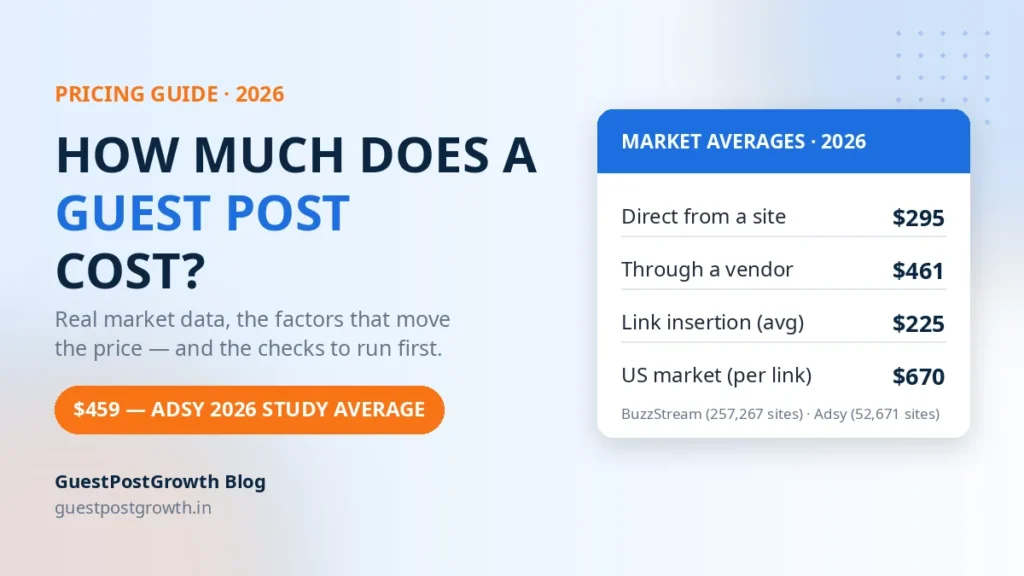
The short answer. In 2026, a guest post costs $295 on average when bought directly from a site, and $461 on average through a vendor, according to BuzzStream’s analysis of 257,267 marketplace sites. Adsy’s 2026 pricing report, covering 52,671 websites, puts the average guest post at $459 and the average link insertion (niche edit) at $225. What any single post costs you depends on the site’s authority, traffic, niche and editorial standards — the sections below break each factor down, and the final section lists the checks to run before paying anyone, including us.
What the market data actually says
Two studies anchor almost every pricing claim in this industry. Both are worth reading in full; here is what they found, with their methods attached so you can judge the numbers yourself.
BuzzStream (published August 2025, updated June 2026) analyzed 257,267 sites with complete Ahrefs Domain Rating (DR), organic traffic and price data, drawn from a major link marketplace:
- Average price: $295 direct from the site, $461 through a vendor.
- Price climbs steeply with DR: roughly $200 from a vendor for a DR 0–9 site, up to about $3,000 for DR 80+.
- Traffic predicts price better than DR alone: about $229 for a site under 100 organic visits a month, $3,210 or more above 100,000 visits a month.
- Quality is scarce by BuzzStream’s own framework: applying their DR-plus-traffic tiers, 96.2% of the sites in their dataset fell into the lowest (“Low Quality”) band and only 1.37% rated High Quality or Top Tier; the average DR across the marketplace was just 24, and 39.6% of sites showed zero estimated monthly organic traffic. Falling into that lowest band is a statement about a site’s DR and estimated traffic, not a finding that every such site is a scam or useless — many are simply small or new.
- Genuinely high-quality posts are expensive: $3,130 on average through a vendor, and $6,018 for top-tier sites.
- By industry (vendor averages), Sports ($572) and News & Media ($567) were the most expensive; Health & Wellness ($352) and Ecommerce ($341) the cheapest.
Adsy (Link Building Pricing Report, February 2026) analyzed its own inventory of 52,671 websites (155,858 for niche and location breakdowns):
- The average guest post price rose 7.5% year on year, from $427 in 2025 to $459 in 2026; a link insertion averages $225, about 56% cheaper than a guest post.
- By DR band: DR 1–30 averages $332 per link, DR 31–70 averages $555, DR 71+ averages $2,025. Each additional 10 DR points adds roughly 32% to the price.
- Geography is a major factor in Adsy’s inventory: its average link price in the United States is $670, in the United Kingdom $729, and in Canada $750 — core English-speaking markets run about 50% above its global average.
- Listed prices are not transaction prices: site owners list at $929 on average, while the typical transaction closes at $207 — buyers overwhelmingly choose the cheaper end of any list.
- By niche, Finance averages $816 per link and Beauty $1,171, while Personal Blogs average $341.
Before comparing the two, be clear about what each one measures — they are not interchangeable. BuzzStream’s figures are asking prices observed across a major link marketplace’s vendor listings, split into an estimated direct price and a vendor price; its quality tiers come from its own DR-plus-traffic framework. Adsy’s figures come from a single marketplace’s own inventory and transactions, reported globally and by country. Different datasets, different definitions, different price types. Used together they triangulate the market’s shape; used as substitutes for each other, they mislead.
With that caveat, the two studies do agree on the shape of the market: a typical, real guest post in an English-speaking market costs a few hundred dollars, quality scarcity pushes good placements into four figures, and a large share of what is sold at the cheap end shows little or no measurable audience.
Why the averages mislead
An “average guest post” does not exist, for three reasons the data makes plain.
First, the average mixes very different inventory. When 96.2% of the sites in BuzzStream’s dataset fall into the lowest band of BuzzStream’s own DR-plus-traffic framework, the average price mostly describes the cheapest, smallest end of the market. That label is methodological — it does not make every site in the band a scam or automatically unsuitable; a small, new, genuinely-read site can sit in it. What it does mean is that the useful question is never “what does a guest post cost?” but “what does a guest post on a site with real readers, in my niche, cost?”
Second, listed prices are asking prices. Adsy’s gap — $929 listed versus $207 typically paid — means any provider’s rate card tells you where negotiation starts, not where value sits. It also means a low price is not automatically a bargain or automatically junk: at the bottom of the market some inventory sits on sites with little genuine audience, which is a reason to inspect the specific site, not a reason to dismiss every low price.
Third, you may be paying for layers, not placements. BuzzStream’s $295 direct versus $461 vendor gap is the cost of outreach, writing, coordination and margin. That layer can be worth paying for — outreach done properly is real work — but you should know it is in the price, and what it includes.
The 7 factors that actually move the price
1. The site’s authority (DR/DA). One of the strongest price drivers — Adsy found DR moves price more than traffic (roughly +32% per 10 DR points), while BuzzStream found traffic the steadier predictor; the two studies weight them differently, which is itself worth knowing. Adsy’s bands — $332 (DR 1–30), $555 (DR 31–70), $2,025 (DR 71+) — are a usable sanity check on any quote. Be suspicious of a “DR 70” site priced like a DR 30 one; metrics can be inflated, and a price far below the band usually means the metric, not the deal, is doing the work.
2. Real organic traffic. Traffic is harder to fake than DR, and BuzzStream found it the steadier price predictor. Ask where a traffic figure comes from and treat “traffic: not available” as information, not a detail. (On our own marketplace, 690 of the 1,502 listed sites show a public third-party traffic estimate; the rest show a dash rather than an invented number.)
3. Niche. Finance, legal and beauty placements cost two to three times what personal-blog placements cost, because fewer legitimate publishers accept commercial content and editorial scrutiny is higher. A quote that ignores your niche entirely is a quote for a generic list.
4. Topical relevance. A post on a site that actually covers your subject costs more than the same metrics on an unrelated generalist site — and is worth more, because relevance is what makes the placement defensible to readers and editors alike. Relevance is the factor with no column in most price lists; insist on it anyway.
5. Editorial standards. Sites with real submission standards — an editor who can reject your article — charge more, because your post appears next to content that passed the same bar. Sites that publish anything for a fee are cheap for a reason, and search engines can see the same pattern you can.
6. Content requirements. Who writes the post, and to what standard? Some providers charge writing on top (one major marketplace, for example, prices articles separately at $25 per 1,000 words). A 1,200-word article written for the host’s readers is a real cost inside any honest quote; a spun or templated article is how a quote gets artificially low.
7. Placement terms. Price should reflect what the terms actually are: whether the link is followed or labelled sponsored, whether the placement is permanent, and what happens if it is removed. A replacement commitment in writing — ours is 12 months on delivered editorial links, set out in our refund policy — is worth more than a verbal promise at a lower price.
Guest post or niche edit: the cost difference
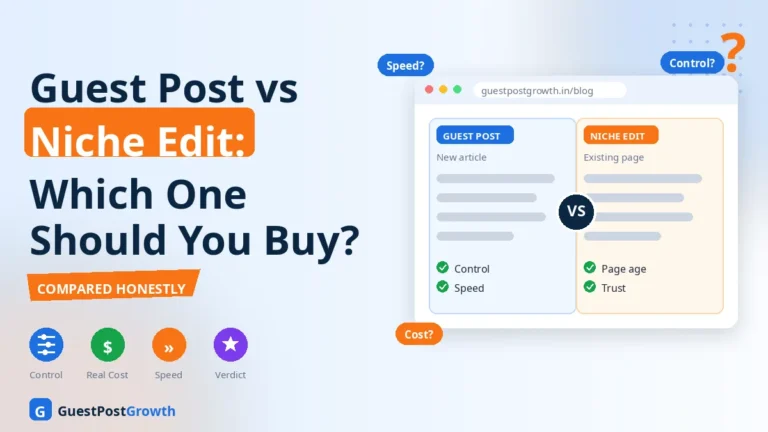
A niche edit — a link inserted into an existing, already-indexed article — averages $225 in Adsy’s data, against $459 for a guest post. The gap exists because no new article is written, published and indexed from zero; you are paying for access to content that already has age and rankings. Neither is automatically better value: a guest post gives you a full article built around your topic, while an edit gives you speed and an established page. We compared the two in depth in guest post vs niche edit: which one should you buy?. Our own niche edit packages start at $41 for a single managed insertion — a different product from Adsy’s figure (a marketplace-wide average across all DR bands), so compare the terms rather than the headline numbers: host screening, the 12-month replacement cover and the delivery report are what the managed price includes.
Editorial value vs buying links to manipulate rankings
This needs saying plainly, because it decides whether any of the prices above are money well spent. Google’s link spam policy lists buying or selling links for ranking purposes as link spam. The same policy explains the compliant route precisely: buying and selling links is a normal part of the web economy for advertising and sponsorship, and it is not a violation as long as those links are qualified with a rel="nofollow" or rel="sponsored" attribute so they do not pass ranking credit.
Two precisions matter here, because they are widely got wrong. First, disclosure alone does not make a paid link compliant. Telling readers that a post is sponsored is good practice and often required by advertising rules, but Google’s mechanism is the link attribute: a paid link left “followed” so it passes ranking credit is link spam under the policy whether or not a disclosure line appears next to it. Second, it follows that no paid placement should be bought — or sold — on a promise of ranking benefit. A provider who qualifies paid links properly is, by design, not selling you ranking credit; a provider who promises rankings from paid followed links is describing exactly the pattern the policy targets.
So what is a paid placement legitimately for? Visibility in front of a real audience on a relevant publication, referral traffic, and a brand footprint you can point to — bought with your eyes open about what it cannot do. Judge prices on that basis: the audience, the relevance and the terms, not a metric and a promise.
Before you pay: 10 checks that take ten minutes
- Is the site named before you pay? Blind “DA tier” packages hide the only thing that matters. If a provider will not show the site, walk away.
- Do the metrics check out? Look the site up yourself; compare its DR and traffic against the bands in the studies above.
- Does it show real traffic — and if the estimate is zero, why? A zero traffic estimate is a warning sign, not a verdict. Traffic figures are third-party estimates and can miss new, small or narrowly-focused sites entirely. If a site shows zero, investigate before deciding either way: is it indexed, does it publish for a recognisable audience, can the seller explain the number? Buy only when the answers make sense.
- Is it relevant to your niche? Read three recent articles. Would your customers read this site?
- Who writes the article, and can you approve it? Writing included, writing extra, or writing templated changes what the price means.
- What are the link terms? Is the paid link qualified with
rel="sponsored"orrel="nofollow"the way Google requires for paid placements, is the commercial nature of the placement disclosed to readers, and is the placement permanent? - What happens if the link disappears? A written replacement or refund term, with a time window — not a verbal assurance.
- Can you see a real sample report? Delivered placements with live URLs (ours are public on the sample report page) beat a mock dashboard screenshot.
- Is there a ranking guarantee? If yes, that is a red flag, not a bonus. Honest providers guarantee the placement and the reporting, not Google’s response.
- Can you start with one? A provider confident in the product sells a single post. Minimum retainers before a first placement shift all the risk to you.
What GuestPostGrowth charges — four different products, kept separate
Our prices are published, so you can run the same checks on us. But compare like with like: we sell four distinct products, and their prices mean different things.
1. Marketplace listings (self-serve, per named site). The guest post sites marketplace lists 1,502 sites with DA, DR and — where a public estimate exists — traffic. 396 of those sites carry a fixed published price today, from $20 to $150 with a median of $80. That price is for a placement on that specific named site, at the terms shown on its listing; the remaining sites are quoted per order once the publisher’s current terms are confirmed. This is the product closest to the marketplaces in the studies above — and even here, note that a fixed listing price and a study average are different kinds of number.
2. Managed guest post packages (we handle outreach and writing). Packaged per-post services in the Backlinks Store start at $22 (a placement aimed at newer, DA 20+ sites) and run through $47–$55 for niche packages (SaaS, tech, finance) to $90 for a post on a DA 90+ site. The article is included — 800–1,800 words depending on the package. These are managed-service prices, not marketplace listing prices, and should not be compared line-for-line with Adsy’s or BuzzStream’s marketplace averages.
3. Niche edits (managed insertions). From $41 for a single insertion, $119 for three, $249 for premium hosts — including host screening and the 12-month replacement cover (see the service page for exactly what each tier covers).
4. Monthly retainers (a managed programme, not a per-post price). From $195/month with no lock-in; the $390 Standard tier includes 8 placements a month across guest posts and niche edits, planned and reported monthly. A retainer price buys an ongoing programme — planning, outreach, placement and reporting — so it does not convert into a per-post figure.
Two honest caveats. First, our inventory is strongest where the market is cheapest — solid mid-authority sites, not the scarce top tier that BuzzStream prices at $3,130 a post on average. If you need a DR 80 publication with 100,000 monthly readers, it costs four figures from any honest seller, and a $150 listing is not a substitute for it. Second, a lower price should never mean lower standards: the same 10 checks above apply to every site on our list, and our sample report shows delivered work you can open and verify before spending anything.
Frequently asked questions
How much does a guest post cost in 2026?
On the best available data, $295 on average bought directly from a site and $461 through a vendor (BuzzStream, 257,267 sites), or $459 on average across Adsy’s 52,671-site inventory; Adsy’s average link price in the US specifically is $670. The two studies measure different datasets and price types, so treat their figures as complementary reference points, not interchangeable ones. Individual prices range from about $20 to several thousand depending on the site’s authority, traffic and niche.
Why do guest post prices vary so much?
Because “a guest post” can mean a placement on a site with no readers or a feature on a publication with a real audience. Authority, traffic, niche, editorial standards, whether writing is included, and the placement terms each move the price — and low-quality inventory dominates the market’s supply, which drags averages down while scarce quality pushes top prices up.
Is a cheap guest post worth buying?
Sometimes — a relevant, real site at a low price exists, particularly among newer publications. Judge the site rather than the price tag either way. One prompt to investigate: BuzzStream found 39.6% of the sites in its dataset showed zero estimated organic traffic. That is a warning sign worth checking (estimates can undercount small or new sites), not proof that a site is worthless. Check indexation, topical relevance and recent content before deciding, and never buy on DR alone.
Which is cheaper, a guest post or a niche edit?
A niche edit, on average: $225 against $459 in Adsy’s 2026 data, because no new article has to be written and indexed. A guest post costs more but gives you a complete article on your topic. Which is better value depends on whether you need new content or an established page — our comparison guide walks through the choice.
Does the price usually include writing?
It varies by provider, and it is one of the first things to confirm. Some marketplaces charge writing separately (one major provider prices it at $25 per 1,000 words); our managed guest post packages include the article in the package price (800–1,800 words depending on the package), and marketplace orders can include writing as specified on the listing.
Are paid guest posts against Google’s rules?
Google’s link spam policy covers buying or selling links for ranking purposes. Paid placements used for advertising or sponsorship are acceptable to Google when the links themselves are qualified with rel=”sponsored” or rel=”nofollow” so they pass no ranking credit — a disclosure label on the article by itself does not make a paid link compliant, because the attribute is the mechanism Google specifies. It follows that paid placements should never be bought on a promise of ranking benefit: buy them for a real audience on relevant sites, on terms you can verify.
How many guest posts should I buy per month?
There is no universal number; the right pace depends on your site’s age, existing link profile and how much new content you are publishing. A steady, modest flow aimed at pages that matter beats a one-off burst. If you would rather have the pacing planned for you, our monthly retainers build the schedule into the service.
The bottom line
In 2026 a typical guest post costs a few hundred dollars on the global averages — more in the US market, where Adsy’s average link price is $670 — a niche edit about half the guest post figure, and a top-tier editorial placement several thousand. Prices below those ranges are not automatically scams, and prices above them are not automatically quality — the site, its audience and the terms decide. Use the studies to sanity-check any quote, run the ten checks before you pay, and start with a single placement you can verify. If you want to see what your budget buys on a published list, browse the marketplace — every price there is one you can check against this guide.
Sources: BuzzStream, “The Cost of Guest Posts, Based on 500k Sites” (257,267 sites analysed; published Aug 2025, updated Jun 2026) — buzzstream.com/blog/guest-post-costs · Adsy, “Link Building Pricing in 2026” (52,671 websites, Feb 2026) — adsy.com/blog/how-much-should-you-pay-for-guest-post · Google Search Central, “Spam policies for Google Web Search” (link spam) — developers.google.com/search/docs/essentials/spam-policies · GuestPostGrowth marketplace inventory, checked live 17 Oct 2026.
Ready to Buy Links the Honest Way?
Browse 1,500+ guest post sites with prices shown upfront, or compare guest post and niche edit packages in the store — every delivered editorial link is covered by our 12-month replacement promise.