Are Profile Backlinks Good for SEO? An Honest Answer
Profile backlinks are the most argued-about cheap link in SEO. Half the industry calls them foundational; the other half calls them spam. Both halves are describing real experiences — they are just describing different versions of the tactic. A complete, genuine profile on a real platform, with your business described properly and your website linked once, is a normal thing for a business to have. Two hundred auto-generated profiles on dead forums, stuffed with keyword anchors, are a footprint no honest practitioner would defend.
This guide separates the two. It explains exactly what profile backlinks do for SEO, what they cannot do, the uncomfortable truth about dofollow and nofollow on big platforms, the five jobs they are genuinely good for, the risks that make people call them spam, and how to judge quality before you spend anything — using a real, published sample of 293 profile domains (ours) that you can inspect yourself, numbers and all.
What Is a Profile Backlink?
A profile backlink is a link to your website from a profile you create on another platform — a social network, a business directory, a community forum, an author or portfolio site, an industry platform. You register, complete the profile with your name or brand, description and details, and the website field carries your link.
That simplicity is both the appeal and the problem. Because profiles are free and quick to create, they became the first link type ever sold in bulk, and the tactic’s reputation still carries the damage from the era of automated profile blasts. The modern, defensible version looks different: real platforms, complete profiles with genuine descriptions and images, consistent business information, one natural link, and a creation pace that looks like a business setting itself up — because that is exactly what it is.
What Profile Backlinks Actually Do for SEO
1. They diversify your link profile
A website linked only by guest posts, or only by any single link type, shows a pattern no real business produces naturally. Real businesses accumulate a messy mixture — profiles, directories, mentions, editorial links, social links. Profile backlinks fill the base of that mixture cheaply and plausibly. Diversity is not a ranking trick; it is what an un-manufactured footprint looks like, and it makes every stronger link you build afterwards safer by contrast.
2. They build your brand’s entity footprint
Search engines increasingly organise the web around entities — real businesses with names, descriptions, locations and presences across platforms. A consistent set of profiles, all describing the same business the same way, helps establish that your brand is a real thing and connects your website to that identity. This is unglamorous work with compounding value: it supports branded search, knowledge panels and the trust checks that happen before rankings are handed out.
3. They help discovery and early indexing
Established platforms are crawled constantly. A new website with profiles on such platforms gives crawlers paths to find it — and gives a brand-new business its first referring domains while it waits for editorial links to arrive. Nobody should promise that profiles will index your site overnight; but a business that exists across the web is simply easier to discover than one that exists only on its own domain.
4. They dilute and balance anchor text
Commercial anchor text — the exact phrases you want to rank for — is risky in concentration. Profile links naturally use branded and URL anchors (your business name, your web address), which is precisely the anchor profile a healthy site shows. Built early, they lower the percentage of aggressive anchors in your overall profile, which protects the editorial links you buy later.
5. They occasionally send real visitors
On platforms with genuine audiences — communities, portfolios, trade directories — a complete profile is a small, permanent advert. The referral traffic is modest and nobody should buy profiles for it, but unlike most cheap links, these ones at least exist in places humans actually visit.
What Profile Backlinks Cannot Do
Honesty is overdue in this corner of SEO, so plainly: profile backlinks will not, by themselves, rank your money pages for competitive searches. They carry little page-level authority — a profile page is rarely linked to, rarely trafficked, and rarely topically deep. They are not a substitute for editorial links, and a strategy consisting only of profiles stalls exactly where you would expect: visible, diversified, and not ranking for anything that makes money.
This is why the correct mental model is a pyramid. Profiles are the wide, cheap base — footprint, diversity, discovery. Above them sit the links that actually move rankings: editorial placements such as guest posts and niche edits, which sit inside real content on real pages. A campaign that buys the base and skips the top is as unbalanced as one that buys the top and skips the base.
The Dofollow Question, Answered Straight
Buyers always ask whether profile links are dofollow. The truthful answer is: it depends on the platform, and on the biggest platforms the answer is usually no. Major social networks and many large directories mark user-submitted links nofollow or ugc — they would be mad not to, at their scale. Smaller, niche and community platforms often leave profile links dofollow.
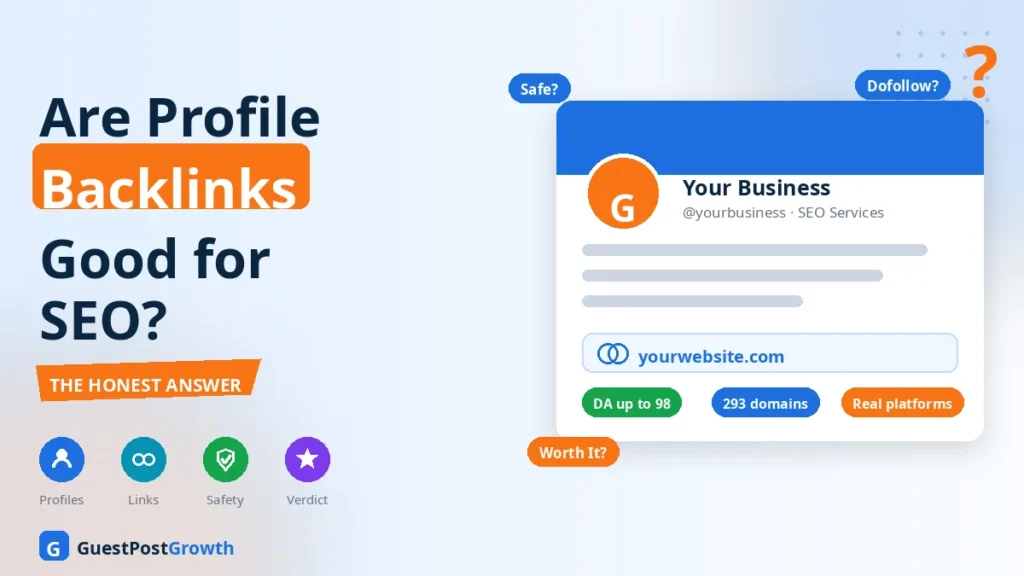
A mixed profile — some dofollow, some nofollow — is not a defect; it is what natural footprints look like, and nofollow links still serve the diversity, entity and referral jobs above. What you should refuse is a seller who promises an all-dofollow pack at scale: that promise usually means the platforms are obscure enough to have no moderation, which tells you everything about their quality. Our own published profile backlinks sample lists 293 real domains with their authority scores shown openly — inspect the mixture yourself rather than trusting adjectives.
When Profile Backlinks Are Worth Buying
A new website with no footprint. Your first referring domains have to come from somewhere, and profiles are the fastest legitimate start — a brand establishing itself across its industry’s platforms looks exactly like a business launching, because it is one.
A local business building citations and presence. Profiles on directories and local platforms overlap with citation work — consistent name, address and phone details everywhere support local rankings as well as the entity footprint.
Before or alongside an editorial campaign. If you are about to invest in guest posts, a base of branded profile links first makes the anchor profile of the whole campaign healthier. This sequencing is built into how we structure affordable SEO services for small businesses — foundations before firepower.
Anchor repair. A site that has over-cooked its commercial anchors in the past can dilute them with a wave of branded profile links — a slow, safe correction compared to removing links.
Brand launches and rebrands. Claiming your name consistently across platforms is basic brand hygiene that also happens to be SEO. Do it once, properly, at launch.
The Risks — and How the Good Version Avoids Them
Profile backlinks earn their bad reputation from three failure modes, all avoidable. First, junk platforms: profiles on hacked, abandoned or link-farm sites associate your brand with neighbourhoods you would never choose. The fix is platform vetting — real sites, real users, real moderation. Second, keyword-stuffed profiles: bios written as anchor-text vehicles (“best cheap SEO services in Texas” as a job title) look exactly like what they are. The fix is writing profiles like a business, not like a link scheme. Third, unnatural velocity: hundreds of profiles appearing in a week for a business that did nothing else. The fix is a pace matched to a launch — steady creation over weeks, inside a wider campaign.
Judged against Google’s policies honestly — the standard we hold this whole site to — paid links intended to manipulate rankings sit in the link-spam policy area whatever their type. Profile creation is also something businesses do legitimately for presence alone, which is why the defensible version is built like presence: real details, genuine descriptions, no ranking promises attached. Anyone who guarantees you rankings from a profile pack has told you, in advance, how they operate.
How to Judge a Profile Backlink Service: The Checklist
- A sample you can inspect before paying. Non-negotiable. Our sample page shows 293 domains with their DA values displayed — the top domain sits at DA 98 and 44 of the domains are DA 90 or above — so a buyer can judge the inventory instead of the adjectives. Ask every seller for the equivalent.
- Complete profiles, not bare registrations. Avatar, bio written for humans, consistent business details, all fields filled. A profile that looks abandoned within a week was made by a script.
- Branded anchors as the default. Business name and naked URL anchors in profiles; commercial phrases are a footprint, not a strategy.
- A realistic platform mix. Social, business, community, author and niche platforms — not 200 subdomains of one network.
- A full delivery report. Every profile URL, live and openable, with login details handed over for the accounts created in your name. Our delivery standard is shown on the sample report page.
- No ranking promises. The seller should describe profiles the way this guide does — foundation work — or not be trusted with the rest of your campaign either.
How Many Profile Backlinks Should You Build?
There is no magic number, and fixed counts sold as prescriptions (“every site needs exactly 300”) are marketing, not analysis. What matters is proportion and pace: profiles should be a base layer under a growing editorial profile, not the whole structure. For most small and new websites, a foundation in the low hundreds of quality profiles — built over weeks, once — is a complete job, after which budget belongs to stronger links: placements on real publications from our guest post sites marketplace, and insertions into aged articles. If a seller’s main argument is a bigger number, they are selling the wrong variable.
Our own pack in the backlinks store is built to that foundation size — 280 profile backlinks, with edu and gov profile placements included where platforms allow — priced at $100 as a one-time foundation purchase rather than a subscription, because a foundation is something you build once and then build upon.
What a Good Profile Actually Looks Like
Because the deliverable is invisible until it is delivered, buyers often cannot picture the difference between a proper profile and a scripted one. A proper profile on any platform has: the business’s real name (not a keyword phrase), a logo or genuine avatar, a description written in sentences a customer could read — what the business does, where, for whom — consistent contact details matching the website, the website link placed in the field the platform intends for it, and every optional field the platform offers completed where the information honestly exists. It looks, in short, like the profile the business would have made for itself, because that is the standard.
A scripted profile has a username like “bestseo2026”, no image, a one-line bio assembled from keywords, and a link. Platforms delete these in batches, which is why bulk packs quietly shrink after delivery — and why a delivery report with live URLs you can re-open months later matters more than the count on the sales page.
Profile Backlinks vs Other Foundation Links
Profiles are not the only foundation layer, and a good campaign mixes its base the way real businesses accumulate it:
| Foundation type | What it is | Main job |
|---|---|---|
| Profile backlinks | Completed profiles on social, business, community and author platforms | Footprint, entity signals, diversity, discovery |
| Citations / directory listings | Name, address and phone listings on directories and maps | Local trust and consistency for location searches |
| Social profiles | The brand’s own accounts on the major social networks | Branded presence; links are almost always nofollow |
| Editorial links | Guest posts and niche edits inside real articles (the layer above) | The actual ranking weight — where serious budget belongs |
Notice the pyramid again: the first three rows are presence, the fourth is power. A healthy new-site campaign buys presence once — profiles, key citations, socials claimed — and then spends monthly on power. Sellers who invert that, pushing ever-larger profile counts as a growth strategy, are selling the cheapest row of this table as if it were the most valuable one.
Frequently Asked Questions
Are profile backlinks good for SEO?
Yes, for foundation jobs: link diversity, brand entity footprint, discovery and anchor balance. They are not a ranking shortcut and will not move competitive keywords alone — they are the base layer that makes an editorial link campaign look natural and work safely.
Do profile backlinks help rankings?
Indirectly. A diversified, branded base supports the links that do the heavy lifting and reduces the risk profile of your overall footprint. Expect profiles to contribute to trust and discovery rather than to push a specific page up the results by themselves.
Are profile backlinks safe?
Built properly — real platforms, complete genuine profiles, branded anchors, a natural pace — they mirror what businesses do for presence anyway and are among the lowest-risk link types. Built as bulk automated blasts on junk platforms with keyword anchors, they become exactly the footprint Google’s link-spam policies describe.
How many profile backlinks should a website have?
No fixed number exists. For most small or new sites, a one-time foundation in the low hundreds of quality profiles is a complete job; after that, budget is better spent on editorial links. Proportion matters more than count — profiles should be the base of the profile, not all of it.
Are profile backlinks dofollow?
Some are, many are not. The largest platforms usually mark profile links nofollow or ugc; smaller and niche platforms often leave them dofollow. A natural mix of both is normal and healthy — be suspicious of any pack promising all-dofollow at scale.
Can I create profile backlinks myself?
Yes — the top platforms for your industry are a realistic DIY afternoon, and claiming your brand’s profiles personally is good hygiene. Buyers use a service for the long tail: the research, the consistent completion of hundreds of profiles, the verification emails and the tidy delivery report are what the money actually purchases.
The Bottom Line
Are profile backlinks good for SEO? They are good for the foundation of SEO — the part nobody brags about and every durable campaign quietly has. Treat them as presence, diversity and discovery; build them like a business, not a blast; inspect the sample before you pay anyone, including us; and spend the serious money on the editorial links that sit on top of the base. That ordering — profiles first, publications second — is the whole secret, and it was never really a secret.
Ready to Buy Links the Honest Way?
Browse 1,500+ guest post sites with prices shown upfront, or compare guest post and niche edit packages in the store — every delivered editorial link is covered by our 12-month replacement promise.
Read Next
How Much Does a Guest Post Cost in 2026?
Oct 16, 2026
12 Affordable SEO Services for Small Businesses
Oct 16, 2026