Guest Post vs Niche Edit: Which One Should You Buy?
Almost every buyer who lands on a link building store asks the same question in one form or another: should I spend my budget on guest posts or on niche edits? The two products sit side by side in almost every catalogue, they are both described as “editorial backlinks,” and the price difference between them is rarely explained. So buyers guess. They buy whichever one a forum thread praised last week, or whichever one is cheaper, and then they judge the entire tactic by the result of that guess.
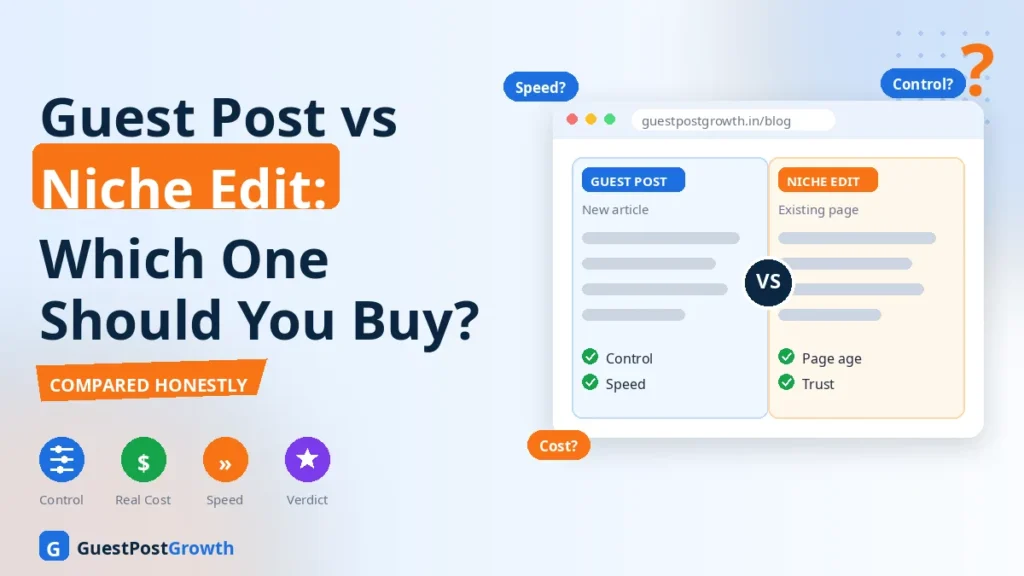
That is a pity, because the guest post vs niche edit decision is not actually close once you understand what each link really is. They are built differently, they age differently, they fail differently, and they are good at different jobs. A guest post is a new article written for a publisher’s site, with your link placed inside it. A niche edit — also called a link insertion — is a link added into an article that already exists on that site. Everything else in this comparison flows from that single structural difference.
This guide is written by a team that sells both, every day, so we will be blunt about the weaknesses of each one — including the weaknesses that cost us sales when buyers walk away. You will find no claim that one is “better” in the abstract. You will find a comparison table, six decision factors, four ready-made scenarios, the quality checks that matter more than the choice itself, and a simple rule for mixing the two. Prices mentioned are real prices from our own store, so you can sanity-check the cost section against the market.
What Is a Guest Post?
A guest post is an original article, written for a specific website, published under that site’s editorial process, containing a link back to your site. You (or your provider) pitch the site, agree a topic, produce the article, the publisher reviews it, and it goes live as a normal piece of content on their blog — indistinguishable in form from anything their own team would publish.
Three things follow from that definition. First, the page carrying your link is new. It starts life unindexed, with no backlinks of its own, no traffic history and no age — everything it becomes, it becomes after publication. Second, you have control. Because the article is created for the placement, you choose the topic, the angle, the surrounding paragraphs, the anchor text and the target URL. Third, the process is slow by nature: pitching, writing, editorial review and scheduling take time. On our own service, guest posts deliver in 5–10 business days, and that is with the publisher relationships already in place.
Guest posts are usually bought in one of three situations: to build topical relevance around a subject your site wants to own, to earn placements on named publications that would never accept an inserted link, or to create a link that also works as a brand asset — an article you can point to, share and be quoted from. You can browse the kind of inventory involved on our guest post sites marketplace, where more than 1,500 publications list their category, metrics and price before you spend anything.
What Is a Niche Edit?
A niche edit is the opposite construction. The article already exists. It was published months or years ago, it is already indexed, it may already rank, attract traffic and hold backlinks of its own — and the publisher agrees to add your link into it, inside a sentence where it genuinely fits. Nothing new is written except, at most, a line or two of bridging text so the link reads naturally.
The consequences mirror the guest post’s. The page is aged and established from day one, which is the entire appeal: instead of waiting for a new page to be indexed and trusted, your link sits on a page Google already knows. You have less control — the topic, structure and most of the wording were fixed long before you arrived, so your influence is limited to the anchor text, the exact sentence and the target page. And the process is faster: there is nothing to write or schedule, so our niche edits service delivers in 3–7 days.
Niche edits are usually bought to strengthen a specific page that needs a push — a service page sitting at position 9 that needs relevant support, a guide that deserves more authority, a product page in a competitive niche — or to add links on strong, aged pages in niches where publishers rarely accept new articles at all.
Guest Post vs Niche Edit: The Comparison Table
Here is the whole comparison on one screen. The sections after it explain the rows that deserve more than a cell.
| Factor | Guest Post | Niche Edit |
|---|---|---|
| The page | Brand-new article, created for the placement | Existing article, published months or years ago |
| Page strength at delivery | Zero — unindexed, no history, no links of its own yet | Already indexed; may have traffic, rankings and its own backlinks |
| Control over content | High — topic, angle, anchor and context are yours | Limited — you choose anchor and sentence, the page is fixed |
| Typical delivery | 5–10 business days | 3–7 days |
| Price on our store | Sites listed $20–$150; DA 90+ package $90/post | From $41 (Basic tier) |
| Brand value | Real — a full article that can be shared and cited | Low — usually a single contextual mention |
| Main risk | The new page may stay weak or orphaned if the site neglects it | The link can be removed when the page is updated or rewritten |
| Best job | Building topical depth and named-publication placements | Strengthening a specific existing page, quickly |
Factor 1: Control Over the Content Around Your Link
This is the guest post’s home ground, and it is not close. When an article is written for your placement, the context is engineered: the article covers exactly the subtopic your target page needs support on, your link appears inside a paragraph that makes a genuine recommendation or citation, and the anchor text is the phrase you would have chosen yourself. If your strategy depends on tight topical matching — supporting a cluster of pages about one subject — guest posts give you a precision that insertions cannot match.
With a niche edit, you are renting space inside somebody else’s argument. A good provider will still work for fit: the page must be on-topic, the sentence must read as if it always belonged, and the anchor stays natural. But you cannot restructure their article around your product, and if the page’s angle is slightly off yours, that angle stays. For many campaigns this hardly matters — a relevant page with a natural mention is a perfectly good link. For launches, rebrands and tightly themed campaigns, it matters a lot.
There is a second, quieter control difference: approval. Our guest post workflow includes draft approval on premium placements — you read the article before it publishes. A niche edit offers approval of the sentence and anchor, not of a document. If being able to read and sign off the full text matters to you or your client, that alone can settle the choice.
Factor 2: Speed — and the Indexation Head Start
Niche edits win the calendar twice over. First, delivery is simply faster: no article to write, no editorial queue, so 3–7 days is a realistic promise rather than an optimistic one. Second — and this is the part buyers underestimate — the clock that matters is not delivery, it is effect. A niche edit lands on a page that Google already crawls regularly. The updated page gets re-crawled, the new link is seen, and it starts counting from a position of established trust.
A guest post, by contrast, begins its life as an unknown URL. It must be discovered, indexed, and then gradually trusted — and a brand-new page on a busy blog can sit unindexed for days or weeks if the site’s internal linking is lazy. Good publishers mitigate this (they link new posts from category pages and related articles), and good providers check indexation rather than just sending you a URL. But the structural truth stands: a guest post’s value ramps up over the following weeks, while a niche edit’s value is largely present at delivery.
Set against that, one honest caveat in the other direction: the niche edit’s head start belongs to the page, not to you. If the host page later gets rewritten, merged or deleted, your link’s history goes with it. The guest post you commissioned is a page created around your link; it tends to be left alone precisely because it is not a living document the publisher keeps editing.
Factor 3: Cost — What Each Dollar Actually Buys
Buyers often compare the two by sticker price and stop there. On our own store the entry numbers look like this: guest post sites list placements from $20 to $150 depending on the publication’s metrics, our DA 90+ guest post package is $90 per post, and niche edits start at $41. Read naively, the niche edit looks like the expensive option and the $20 guest post looks like a bargain. Read properly, the numbers are buying different things.
A guest post’s price mostly buys production: outreach, writing, editorial handling and the publisher’s fee for new content. What it does not buy is page history — the page your money creates has none. A niche edit’s price mostly buys access: a slot on a page that already exists, already ranks or already holds links. You are paying for the years that page has behind it. That is why a niche edit on a genuinely strong page can cost more than a guest post on the same domain — and why the comparison only makes sense page-to-page, never product-to-product.
Two cost traps deserve naming. The first is the ultra-cheap guest post: at prices below the cost of writing a decent article, what usually arrives is spun or AI-churned text on a site that sells posts to everyone — the kind of placement that adds a referring domain to a report and nothing to your rankings. The second is the niche edit priced off domain metrics alone: an insertion on a high-DA page that receives no traffic, ranks for nothing and sits in an unrelated category is worth very little, whatever the domain’s score says. In both cases the tactic is not the problem; the vetting is. Section nine of this guide is a checklist for exactly that.
Budget reality check, using our store’s numbers: a starter month built only from guest posts might be four mid-range placements at roughly $60 each. The same spend as niche edits buys fewer, stronger insertions. A mixed month — the pattern our monthly SEO retainer usually follows — puts guest posts behind the topics you are building and niche edits behind the pages you are pushing. Cost per link is the wrong metric anyway; cost per useful link is the one that survives contact with a rankings report.
Factor 4: Page Strength — New Page vs Aged Page
Underneath every other factor sits this one: where does the link’s strength come from? A backlink’s value is mostly a property of the page it sits on — its topical relevance, its own incoming links, its traffic — with the domain’s overall authority as supporting evidence. This is why our marketplace lists page-relevant data, and why serious buyers have learned to ask “what does the linking page look like?” before “what is the DA?”
By that standard, a fresh guest post page starts at zero on every axis. Its strengths arrive later, if they arrive: the publisher’s internal links give it a path to indexation, the site’s authority lends it credibility, and sometimes the article itself earns links or traffic. Plenty of guest posts become genuinely valuable pages. But at the moment of delivery, you are holding potential, not strength.
A niche edit inverts the profile. The page’s strength — its age, its indexation, its existing backlinks and rankings — exists before your link is added, and your link inherits all of it immediately. When buyers report that niche edits “work faster,” this inheritance is most of what they are feeling. The corresponding weakness is dependence: you did not build that strength, you cannot control it, and the page can change under you. Our delivered editorial links — both types — are covered by a 12-month replacement promise for exactly this reason, and it is a term worth demanding from any provider.
Factor 5: Risk and Safety, Honestly
Both tactics live in the same policy neighbourhood, and pretending otherwise would be dishonest: paying for links that pass ranking credit sits against Google’s link spam policies, which is why the honest framing is about how the links are built, not a promise that any paid link is risk-free. Anyone who guarantees you safety — or rankings — is selling you a story. What quality actually changes is the profile of the risk.
Guest posts carry their risk in footprint and quality. A guest post programme run at scale on sites that accept anything leaves an obvious pattern: thin articles, repetitive anchors, the same author bios. Run editorially — real sites, real review, articles a reader would finish — the placement is a normal article with a normal link, and the residual risk is the ordinary one attached to any paid placement.
Niche edits carry their risk in naturalness and permanence. A link wedged into an old article where it does not belong is visible to anyone who reads the page, human or algorithmic. And because the page is a living document, edits can be overwritten: content refreshes, site migrations and redesigns quietly remove inserted links, which is why delivery reports and replacement cover matter more for niche edits than for almost any other product. Our refund policy spells out, in writing, what happens in each of those cases — read any provider’s equivalent page before you buy either tactic.
The risk neither tactic can remove is disclosure. Reputable publishers mark paid placements as sponsored where their policies require it, and link attributes are ultimately the publisher’s call — on our press and editorial products we say this plainly rather than promising an attribute we do not control. A provider who guarantees a specific link attribute on someone else’s website is guaranteeing something that is not theirs to give.
Factor 6: Brand Value and Referral Traffic
A guest post is the only one of the two that can work as a brand asset. A full article on a publication your audience reads puts your name, your argument and your expertise in front of them — and it can be quoted, shared and linked onward. Some of that value is hard to measure, which is exactly why buyers underrate it: the spreadsheet counts the link, not the founder who read the article and became a customer three months later.
A niche edit, by contrast, is almost purely an SEO instrument. A sentence and an anchor inside someone else’s article will occasionally send a click, but nobody buys insertions for referral traffic. Judge each product by its own job description: if a campaign needs visibility as well as links — a launch, a new market, a founder-led brand — guest posts earn their slower timeline. If the job is purely to move specific pages in the results, the niche edit’s lack of brand value is irrelevant.
So Which One Should You Buy? Four Scenarios
Scenario 1: A new website with no authority yet
Lean guest posts. A new site needs topical breadth first — a set of relevant articles across real publications that establish what the site is about and who vouches for it. Niche edits can wait until there are pages worth pushing; strengthening a page nobody can find yet, on a site with no topical base, is spending in the wrong order. Start with placements you can inspect first — our sample report shows the format and standard of what we deliver before you commit to a package.
Scenario 2: An existing page stuck just below the top results
Lean niche edits. When a page already ranks on page one or two and needs relevant support, an insertion on an aged, on-topic page is the fastest legitimate lever you have: the linking page is already trusted, and the boost lands on exactly the URL that needs it. This is the classic niche edit job, and it is where the tactic earns its reputation.
Scenario 3: A local business that needs leads, not articles
Mostly niche edits, plus citations and profiles rather than classic guest posts. Local rankings respond to relevance and prominence signals close to home; a link inside an existing local guide or resource page usually beats a fresh article on a national blog. Guest posts still have a place when a genuinely local publication will take one — a regional magazine feature is both a link and an advert — but they are the garnish, not the meal.
Scenario 4: An agency buying for clients
Both, deliberately separated by client stage — and this is where most of our backlink packages end up. New client sites get guest-post-led foundations; established clients get niche-edit-led pushes on money pages; reporting separates the two so clients can see which lever produced what. Agencies also feel the approval difference most: clients like reading a guest post draft, while niche edits need a clear before/after report to feel tangible.
The Smart Answer for Most Sites: Combine Them
Notice that every scenario above leans rather than chooses. That is deliberate. Real link profiles are mixed — a site linked only by fresh guest posts looks as manufactured as a site linked only by insertions. The combination also hedges the two tactics’ opposite weaknesses: guest posts are slow but durable and controllable; niche edits are fast but dependent on pages you do not own.
A practical monthly rhythm, at the scale of our Growth retainer, looks like this: two to four guest posts aimed at the topics and clusters you are building this quarter, and two to three niche edits aimed at the pages currently closest to the money — a service page at position 8, a guide at position 12. Anchors rotate across branded, partial-match and natural phrases for both. Every placement is reported with its live URL, and anything that drops inside twelve months is replaced. You can see the packages this rhythm is built from in the store, including the DA 90+ guest post package for the heavy placements.
The Checklist That Matters More Than the Choice
Here is the uncomfortable truth this whole guide has been walking towards: a well-vetted niche edit beats a sloppy guest post, and a well-vetted guest post beats a sloppy niche edit. The vetting is the product. Whichever you buy, check these before money moves:
- Real traffic. The site should have visible, plausible organic traffic — not a metrics screenshot from the seller.
- Topical fit. The site, and ideally the exact page, should be about your subject or a genuinely adjacent one.
- Editorial standards. The site publishes content a human would read, and says no to some submissions. A site that accepts everything is a link farm with better branding.
- Outbound link profile. If every article links out to casinos, essay mills and crypto schemes, your link keeps that company.
- Page-level evidence for niche edits. Ask what the specific page ranks for and what links it holds — not just the domain’s score.
- Internal linking for guest posts. New articles should be linked from the site’s own pages, not left orphaned.
- Written terms. Delivery window, what the delivery report contains, and what happens if a link is removed — in writing, before payment. Our own terms sit on the refund policy page linked earlier; hold every provider to the same standard.
Five Mistakes Buyers Make With Both
Judging by domain metrics alone. DA and DR describe a domain’s overall link profile; your ranking effect comes mainly from the page. A modest domain with a perfect page beats a famous domain with an irrelevant one.
Using the same anchor everywhere. Exact-match anchors repeated across placements are the clearest footprint either tactic can leave. Vary them the way real mentions vary.
Buying volume before quality. Fifty cheap placements of either type routinely underperform five good ones — and they are far harder to clean up.
Expecting a timeline nobody can promise. Niche edits usually show their effect sooner; guest posts build over weeks. Anyone quoting you an exact ranking date is inventing it.
Never checking the delivered links again. Links of both types can disappear. A quarterly spot-check — or a provider whose replacement cover makes it their problem — is basic hygiene.
Frequently Asked Questions
Are niche edits better than guest posts for SEO?
Neither is better in general. Niche edits usually act faster because the linking page is already indexed and trusted; guest posts give you full control over topic and context and tend to age into more durable assets. The better choice depends on whether you need speed on an existing page or depth around a topic.
What is the main difference between a guest post and a niche edit?
A guest post is a new article created on a publisher’s site with your link inside it. A niche edit adds your link into an article that already exists on that site. Everything else — speed, control, price structure, risk — follows from that one difference.
How much does a guest post cost compared to a niche edit?
On our store, guest post sites list placements from $20 to $150 depending on the publication, our DA 90+ guest post package is $90 per post, and niche edits start at $41. Guest post prices mostly pay for production (writing and editorial handling); niche edit prices mostly pay for access to an aged page.
Do niche edits work for new websites?
They work, but usually not first. A brand-new site benefits more from building topical breadth with guest posts; niche edits become the better tool once you have specific pages ranking within reach of page one that need support.
How long do guest posts and niche edits take to deliver?
On our services, guest posts deliver in 5–10 business days (pitching, writing and editorial review included) and niche edits in 3–7 days. Any provider quoting same-day delivery for genuine editorial placements is telling you something about the placement.
Can I use guest posts and niche edits in the same campaign?
Yes — most strong campaigns do. A common pattern is guest posts building topical coverage while niche edits support the pages closest to generating revenue, with anchors varied across both. Our monthly retainers are structured exactly that way.
What happens if my link is removed later?
On GuestPostGrowth, delivered editorial links are covered by a 12-month replacement promise: if a covered link is removed inside that window, we replace it or, where replacement is impossible, refund it under the terms on our refund policy page. Whatever provider you use, get the equivalent promise in writing before you pay.
The Verdict
Guest post vs niche edit is not a contest with a winner; it is a routing decision. Route guest posts to topics you are building and publications you want your name on. Route niche edits to pages that already matter and need trusted support quickly. Vet the site and the page harder than you debate the tactic, insist on written terms and a real delivery report, and the two will do together what neither does as well alone.
If you want to price a real campaign instead of a hypothetical one, browse the guest post sites marketplace for publications, compare the tiers on the niche edits service page, or talk to the team on WhatsApp and tell us which pages you are trying to move — we will tell you honestly which of the two we would buy in your position, including when the answer is “neither yet.”
Ready to Buy Links the Honest Way?
Browse 1,500+ guest post sites with prices shown upfront, or compare guest post and niche edit packages in the store — every delivered editorial link is covered by our 12-month replacement promise.
Read Next
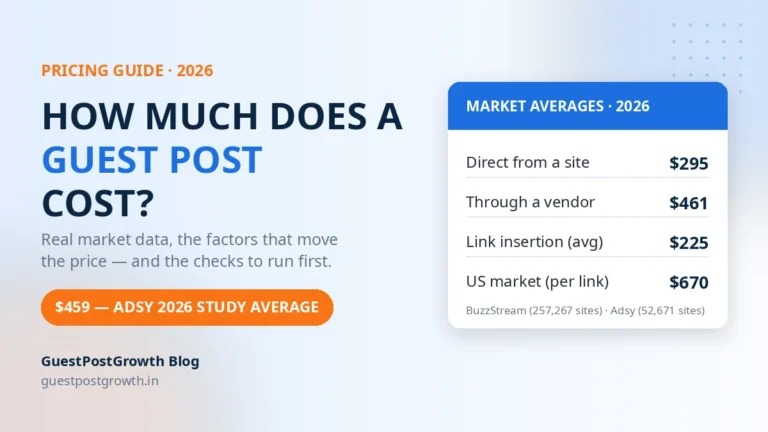
How Much Does a Guest Post Cost in 2026?
Oct 16, 2026
12 Affordable SEO Services for Small Businesses
Oct 16, 2026